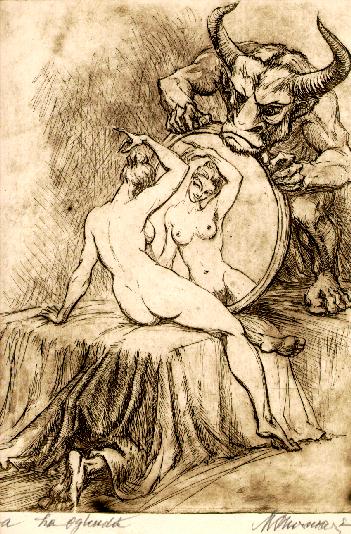
Marcel Chirnoagă (August 17, 1930, Buşteni - April 23, 2008) was a renowned Romanian artist. He graduated in 1952 the Faculty of Mathematics and Physics, Bucharest, following simultaneously liberal arts studies. He was member of Artists Union of Romania since 1953.
Marcel Chirnoagă made, over his lifetime, more than 3,000 works, excelling in drawings, engravings, paintings and sculptures, while being the author of one of the most important works of the Romanian 20th century, the cycle of engravings "Revelation".
Images from here. Visit for more!
|
|
|---|
Showing posts with label painter. Show all posts
Monday, June 14, 2010
Sunday, June 13, 2010
Ştefan Dimitrescu
Ştefan Dimitrescu (January 18, 1886, Huşi – May 22, 1933, Iaşi) was a Romanian Post-impressionist painter and draftsman.
Born in Huşi into a modest family, he completed his primary and secondary studies in his hometown. In 1902, deciding to follow his passion for music, he left for Iaşi, where he took cello classes at the Iaşi Conservatory. In summer of 1903, Dimitrescu entered the National School of Fine Arts in the city, studying in the same class as Nicolae Tonitza; the two studied under Gheorghe Popovici and Emanoil Bardasare. After graduation, Dimitrescu painted murals for the Orthodox churches in Agăş and Asău (Bacău County). Between 1912 and 1913, he studied in Paris, at the Académie de la Grande Chaumière, during which time he was attracted to Impressionism.
Drafted into the Romanian Army at the start of the Romanian Campaign of World War I, Dimitrescu was profoundly touched by the experience, and began painting tragic pieces that documented the misery brought by the conflict. Like his friend Tonitza, he began exploring social themes, such as queuing and the effects of bombardments.
In 1917, along with the painters Camil Ressu, Iosif Iser, Marius Bunescu and the sculptors Dimitrie Paciurea, Cornel Medrea, Ion Jalea and Oscar Han, he founded the Art of Romania association in their Iaşi refuge. In 1926, Dimitrescu, with Oscar Han, Francisc Şirato, and Nicolae Tonitza, established Grupul celor patru ("The Group of Four").
He became a teacher at the Iaşi National School of Fine Arts in 1927, and, during the next year, he was named its headmaster (a position he held until his death). Towards the end of his life, Dimitrescu began expanding his palette to cover more somber colors, while exploring compositions in which the background was stripped of details and usually of a dominant white.
Most of Dimitrescu's paintings take inspiration mainly from the life of simple folk, and especially from that of Romanian peasants and miners; they attempt to portray Romanian traditions and way of life, drawing on his encounters with both Byzantine art and the work of Paul Cézanne.
Part of his art (between 1926 and 1933) was inspired by his travels to Dobruja, and have been considered to be the most accomplished synthesis between his craft as a draftsman and his art as a painter.
Many of his works are exhibited in Bârlad (at the Vasile Pârvan Museum), Bucharest (the National Museum of Art of Romania and the Zambaccian Museum), Cluj-Napoca (Cluj Art Museum) and in private collections outside Romania (in Austria, Belgium, France and Germany).
From Wikipedia.
Born in Huşi into a modest family, he completed his primary and secondary studies in his hometown. In 1902, deciding to follow his passion for music, he left for Iaşi, where he took cello classes at the Iaşi Conservatory. In summer of 1903, Dimitrescu entered the National School of Fine Arts in the city, studying in the same class as Nicolae Tonitza; the two studied under Gheorghe Popovici and Emanoil Bardasare. After graduation, Dimitrescu painted murals for the Orthodox churches in Agăş and Asău (Bacău County). Between 1912 and 1913, he studied in Paris, at the Académie de la Grande Chaumière, during which time he was attracted to Impressionism.
The grandfather
Drafted into the Romanian Army at the start of the Romanian Campaign of World War I, Dimitrescu was profoundly touched by the experience, and began painting tragic pieces that documented the misery brought by the conflict. Like his friend Tonitza, he began exploring social themes, such as queuing and the effects of bombardments.
Peasant women from Sălişte
In 1917, along with the painters Camil Ressu, Iosif Iser, Marius Bunescu and the sculptors Dimitrie Paciurea, Cornel Medrea, Ion Jalea and Oscar Han, he founded the Art of Romania association in their Iaşi refuge. In 1926, Dimitrescu, with Oscar Han, Francisc Şirato, and Nicolae Tonitza, established Grupul celor patru ("The Group of Four").
Turks in Mangalia
He became a teacher at the Iaşi National School of Fine Arts in 1927, and, during the next year, he was named its headmaster (a position he held until his death). Towards the end of his life, Dimitrescu began expanding his palette to cover more somber colors, while exploring compositions in which the background was stripped of details and usually of a dominant white.
Landscape from Mangalia
Most of Dimitrescu's paintings take inspiration mainly from the life of simple folk, and especially from that of Romanian peasants and miners; they attempt to portray Romanian traditions and way of life, drawing on his encounters with both Byzantine art and the work of Paul Cézanne.
Women on the beach
Part of his art (between 1926 and 1933) was inspired by his travels to Dobruja, and have been considered to be the most accomplished synthesis between his craft as a draftsman and his art as a painter.
Peasant women working at a loom
Many of his works are exhibited in Bârlad (at the Vasile Pârvan Museum), Bucharest (the National Museum of Art of Romania and the Zambaccian Museum), Cluj-Napoca (Cluj Art Museum) and in private collections outside Romania (in Austria, Belgium, France and Germany).
From Wikipedia.
Friday, June 11, 2010
Sabin Bălaşa
Sabin Bălaşa (June 17, 1932, Dobriceni - April 1, 2008, Bucharest) was a contemporary Romanian painter. His works are described by himself as belonging to cosmic Romanticism. He was also an author, writer and director of animated painting films.
In 1956 he graduated the Art Academy in Bucharest and he followed the courses of Art Academies from Siena and Perugia – Italy. He naturally started from the traditions of the Romanian art, which he assimilated in a creative way, and studied with interest and fervor the history and mythology of the Romanian people, pledging himself to conjure up a fascinating universe of great expressive power, conveying to the onlooker an impression or a rare strength.
Among Bălaşa's most notable works are several large-scale fresco paintings, which decorate the inside of the Alexandru Ioan Cuza University of Iaşi. The Hall of the Lost Footfalls was painted over a period of 10 years and consists in 18 great wall paintings. Main themes include youth, the history and poetry of the Romanian people.
Whether he painted such heroes of the national pantheon as Decebalus, Stephen the Great, Bălcescu or Eminescu, evoked characters of legend, epic or ballad or creates images living beyond time and space, Sabin Bălaşa constantly remains faithful to the most generous and noble human ideals.
He had many personal exhibitions in Warsaw (1955), Moscow (1958), Cairo, Alexandria, Damasc (1960-1961), Youth Biennial in Paris (1961), Pescara – Italy (1965), Roma (1966), Orly (1968), Torino, Roma (1969), Tel-Aviv, Yugoslavia, Bulgary, Japan (1970-1972), Conges sur Mer – France (1973), Cuba (1974), Greece, Russia, Finland (1976), Norway, Sweden, USA (1978) and many others. Some of his works are exhibited in many museums and are part of private collections all over the world.
Between 1966 and 1976 he created and directed 12 animated painting films. He was a member of the Jury at the international festivals of the animation films - Annecy (France - 1973). He has written novels such "The Blue Desert" (1996), "Exodus Toward The Light" (2002).
Images from here. Visit for more!
In 1956 he graduated the Art Academy in Bucharest and he followed the courses of Art Academies from Siena and Perugia – Italy. He naturally started from the traditions of the Romanian art, which he assimilated in a creative way, and studied with interest and fervor the history and mythology of the Romanian people, pledging himself to conjure up a fascinating universe of great expressive power, conveying to the onlooker an impression or a rare strength.
Universe of love
Among Bălaşa's most notable works are several large-scale fresco paintings, which decorate the inside of the Alexandru Ioan Cuza University of Iaşi. The Hall of the Lost Footfalls was painted over a period of 10 years and consists in 18 great wall paintings. Main themes include youth, the history and poetry of the Romanian people.
The Ball of Phantoms
Whether he painted such heroes of the national pantheon as Decebalus, Stephen the Great, Bălcescu or Eminescu, evoked characters of legend, epic or ballad or creates images living beyond time and space, Sabin Bălaşa constantly remains faithful to the most generous and noble human ideals.
Traveler in Time
He had many personal exhibitions in Warsaw (1955), Moscow (1958), Cairo, Alexandria, Damasc (1960-1961), Youth Biennial in Paris (1961), Pescara – Italy (1965), Roma (1966), Orly (1968), Torino, Roma (1969), Tel-Aviv, Yugoslavia, Bulgary, Japan (1970-1972), Conges sur Mer – France (1973), Cuba (1974), Greece, Russia, Finland (1976), Norway, Sweden, USA (1978) and many others. Some of his works are exhibited in many museums and are part of private collections all over the world.
Vision
Between 1966 and 1976 he created and directed 12 animated painting films. He was a member of the Jury at the international festivals of the animation films - Annecy (France - 1973). He has written novels such "The Blue Desert" (1996), "Exodus Toward The Light" (2002).
The Cavalcade
Wedding Traveling in Space
Images from here. Visit for more!
Labels:
author,
Cosmic Romanticism,
director,
painter,
Sabin Bălaşa,
surrealism,
writer
Monday, June 7, 2010
Alexandra Nechita, the "Petite Picasso"
Alexandra Nechita (born August 27, 1985) is a Romanian-born American cubist painter and muralist.
She was born in Vaslui, Moldavia, three months after her father, Niki Nechita, escaped from Communist Romania. She and her mother, Viorica Nechita, waited two years to rejoin him in the United States. The family settled in California, where her father found work as a lab technician, and her mother as an office manager.
At the age of two, she was working with pen and ink and by five was working with watercolors. Upon her seventh birthday, oil and acrylics were her tools. She had her first solo exhibition at the age of eight at the public library in Whittier, Los Angeles County. Her talent led to her being known as the "Petite Picasso" as her work, to some, resembles that of the master; she has been known as a child prodigy until late in her teens.
She has been featured on the Oprah Winfrey Show and has appeared with numerous celebrities, including Bill Clinton. She had a guest appearance as herself in the Touchstone Television sitcom Boy Meets World in the 1998 episode "Better Than The Average Cory".
In November 1999, Alexandra was selected by the World Federation of United Nations Associations to lead a Global Arts Initiative involving more than 100 nations. In 2005, Alexandra Nechita unveiled her United Nations Peace Monument for Asia in Singapore. It is to be set up for display at the Catholic High School. She was also enlisted to make a series of paintings named "Winning Together" for the Special Olympics.
She dedicated a theatre at the Lutheran High School of Orange County, which was her high school. It is known as the Nechita Center for the Arts, and has 740 seats. She has a degree in Fine Arts from UCLA.
After Wikipedia.
She was born in Vaslui, Moldavia, three months after her father, Niki Nechita, escaped from Communist Romania. She and her mother, Viorica Nechita, waited two years to rejoin him in the United States. The family settled in California, where her father found work as a lab technician, and her mother as an office manager.
At the age of two, she was working with pen and ink and by five was working with watercolors. Upon her seventh birthday, oil and acrylics were her tools. She had her first solo exhibition at the age of eight at the public library in Whittier, Los Angeles County. Her talent led to her being known as the "Petite Picasso" as her work, to some, resembles that of the master; she has been known as a child prodigy until late in her teens.
She has been featured on the Oprah Winfrey Show and has appeared with numerous celebrities, including Bill Clinton. She had a guest appearance as herself in the Touchstone Television sitcom Boy Meets World in the 1998 episode "Better Than The Average Cory".
In November 1999, Alexandra was selected by the World Federation of United Nations Associations to lead a Global Arts Initiative involving more than 100 nations. In 2005, Alexandra Nechita unveiled her United Nations Peace Monument for Asia in Singapore. It is to be set up for display at the Catholic High School. She was also enlisted to make a series of paintings named "Winning Together" for the Special Olympics.
She dedicated a theatre at the Lutheran High School of Orange County, which was her high school. It is known as the Nechita Center for the Arts, and has 740 seats. She has a degree in Fine Arts from UCLA.
After Wikipedia.
Thursday, April 29, 2010
Camil Ressu
Camil Ressu (January 28, 1880, Galaţi – April 1, 1962, Bucharest) was a Romanian painter and academic, one of the most significant art figures of Romania.
Born in Galaţi, Ressu originated from an Aromanian family that migrated to Romania from Macedonia at the start of the 19th century. His father, Constantin Ressu, who was a journalist and had studied law in Brussels, was an artist in his spare time. From 1897 to 1899 Camil Ressu studied at the Fine Arts School in Bucharest with Professor G.D. Mirea. He continued his studies at the Fine Arts School in Iaşi, where he studies with painters Gheorghe Popovici and Gheorghe Panaiteanu Bardasare, and finished his studied in Iaşi in 1902, being awarded a silver medal. In 1902, after a visiting tour of the Munich museums, he would go to Paris for studying at the Julian Academy as an apprentice to Jean Paul Laurens.
After coming back to Romania in 1908, he contributed satirical drawings for such publications as "Adevărul", "Furnica", "Facla" and "Cronica". Soon he joined the "Artistic Youth" events, participating in official salons and other group exhibitions in the country or abroad. During his life he had two personal exhibitions in Bucharest (in 1914 and 1955 respectively). In 1917 he was one of the founding members of the "Romanian Art" Society, to include painters Nicolae Dărăscu, Ştefan Dimitrescu, Iosif Iser, Marius Bunescu and the sculptors Dimitrie Paciurea, Cornel Medrea, Ion Jalea and Oscar Han. Also he was on the initiative taken in 1921 for setting up the Romanian Plastic Artists' Trade Union he was to preside over for two years. He founded the Art of Romania association in Iaşi.
He was Professor and Rector of the Academy of Fine Arts in Bucharest so far as 1941. Starting with 1950, he was honorary president of the Plastic Artists' Union, to resume at the same time his academic position as professor at the "N. Grigorescu" Arts Institute. He was awarded in 1955 the People's Artist title, to become one year later a member of the Romanian Academy. Being largely exercised in studies of human body, of landscapes and objects under his eyes, he would, conscious of the drawing and colors performance, dare to innovate the art language while keeping the traditional values intact. His attachment to traditional values was mainly proved by his pictures of the village world seen as an immemorial preserver of those traditions.
Born in Galaţi, Ressu originated from an Aromanian family that migrated to Romania from Macedonia at the start of the 19th century. His father, Constantin Ressu, who was a journalist and had studied law in Brussels, was an artist in his spare time. From 1897 to 1899 Camil Ressu studied at the Fine Arts School in Bucharest with Professor G.D. Mirea. He continued his studies at the Fine Arts School in Iaşi, where he studies with painters Gheorghe Popovici and Gheorghe Panaiteanu Bardasare, and finished his studied in Iaşi in 1902, being awarded a silver medal. In 1902, after a visiting tour of the Munich museums, he would go to Paris for studying at the Julian Academy as an apprentice to Jean Paul Laurens.
After coming back to Romania in 1908, he contributed satirical drawings for such publications as "Adevărul", "Furnica", "Facla" and "Cronica". Soon he joined the "Artistic Youth" events, participating in official salons and other group exhibitions in the country or abroad. During his life he had two personal exhibitions in Bucharest (in 1914 and 1955 respectively). In 1917 he was one of the founding members of the "Romanian Art" Society, to include painters Nicolae Dărăscu, Ştefan Dimitrescu, Iosif Iser, Marius Bunescu and the sculptors Dimitrie Paciurea, Cornel Medrea, Ion Jalea and Oscar Han. Also he was on the initiative taken in 1921 for setting up the Romanian Plastic Artists' Trade Union he was to preside over for two years. He founded the Art of Romania association in Iaşi.
He was Professor and Rector of the Academy of Fine Arts in Bucharest so far as 1941. Starting with 1950, he was honorary president of the Plastic Artists' Union, to resume at the same time his academic position as professor at the "N. Grigorescu" Arts Institute. He was awarded in 1955 the People's Artist title, to become one year later a member of the Romanian Academy. Being largely exercised in studies of human body, of landscapes and objects under his eyes, he would, conscious of the drawing and colors performance, dare to innovate the art language while keeping the traditional values intact. His attachment to traditional values was mainly proved by his pictures of the village world seen as an immemorial preserver of those traditions.
Labels:
academic,
Camil Ressu,
Galaţi,
painter,
Romanian Academy
Tuesday, April 27, 2010
Ion Andreescu
Ion Andreescu (February 15, 1850 – October 22, 1882) was a renowned Romanian painter.
He was born in Bucharest into a merchant's family. In 1863 he learned drawing with Professor Petre Alexandrescu, then he studied with H. Trenk at "Gheorghe Lazăr" College in Bucharest. He distinguishes itself in the drawing class of the "Saint Sava" College. In 1869 he entered Theodor Aman's Fine Arts School.
By 1872 he was an instructor of drawing and calligraphy at the "Bishopric School" in Buzău. In 1873 he left it for the "Tudor Vladimirescu Communal Secondary School", also in Buzău. Then, in 1875 he teached at the "Craftsmanship School" in the same town.
Influenced by Nicolae Grigorescu, he left Romania for Paris in 1878 to further his education at Julian Academy. In Paris, he began painting at Barbizon. His work was exhibited with the works of better known painters such as Manet, Monet and Renoir. In 1881 he returned to Romania, ill with tuberculosis. His death followed shortly in 1882.
Although he lived only 32 years, Ion Andreescu proved that he had an exceptional talent. His artistic creation to be reduced to a few hundred paintings - sober, profound, serious and meditative. "Among the Romanian painters, there isn't another personality more attractive than Ion Andreescu and with destiny more full of meanings. In fact, he guided the Romanian art in a decisive manner" - wrote the French critic Jacques Lassaigne.
From Wikipedia.
Self portrait (1882)
He was born in Bucharest into a merchant's family. In 1863 he learned drawing with Professor Petre Alexandrescu, then he studied with H. Trenk at "Gheorghe Lazăr" College in Bucharest. He distinguishes itself in the drawing class of the "Saint Sava" College. In 1869 he entered Theodor Aman's Fine Arts School.
Beech forest
By 1872 he was an instructor of drawing and calligraphy at the "Bishopric School" in Buzău. In 1873 he left it for the "Tudor Vladimirescu Communal Secondary School", also in Buzău. Then, in 1875 he teached at the "Craftsmanship School" in the same town.
Woods in winter
Street at Barbizon during the summer
Although he lived only 32 years, Ion Andreescu proved that he had an exceptional talent. His artistic creation to be reduced to a few hundred paintings - sober, profound, serious and meditative. "Among the Romanian painters, there isn't another personality more attractive than Ion Andreescu and with destiny more full of meanings. In fact, he guided the Romanian art in a decisive manner" - wrote the French critic Jacques Lassaigne.
The red scarf
The oak
From Wikipedia.
Labels:
Barbizon,
Ion Andreescu,
Nicolae Grigorescu,
painter,
Paris,
Theodor Aman
Wednesday, March 17, 2010
Hedda Sterne
Hedda Sterne (born August 4, 1910, in Bucharest, Romania), is an artist known for maintaining a stubborn independence from styles and trends, including Surrealism and Abstract Expressionism, with which she is often associated.
Hedda Sterne was born in Bucharest in 1910 as Hedwig Lindenberg. She was the second child with her only sibling, Edouard, who later became a prominent conductor in Paris. Sterne was raised with artistic values from a young age, most notably, her tie to Surrealism, which stemmed from a family friend, Victor Brauner. Sterne was home schooled until age 11. Upon her high school graduation in 1927,at age 17, she attended art classes in Vienna, then had a short attendance at the University of Bucharest studying philosophy and art history before she dropped out to pursue artistic training independently. She spent time traveling, especially to Paris developing her technical skills as both a painter and sculptor. She studied with Fernand Leger and Andreé Lhote, first exhibiting with the Surrealists in Paris (in a group show, the 11th Exposition du Salon des Surindépendants, in Paris in 1938). Hedda Sterne married a childhood friend Frederick Sterne in 1932 when she was 22. In 1941 she escaped a certain death from Nazi encroachment during WWII when she fled to New York to be with her husband Frederick Sterne. In 1944 she remarried Saul Steinberg and became a U.S. citizen. It is not mentioned if she ever had children. She was involved in many shows and exhibits in New York and practiced her art up until she had a stroke that affected her vision and movement when she was 94. She is still alive however unable to follow her passions of drawing.
The year 1941 was a landmark year for Sterne as her move to New York was overshadowed by her inclusion in the Art of This Century exhibition, funded by Peggy Guggenheim. It was here where notable dealer Betty Parsons discovered Sterne’s work and gave her a solo exhibition at the Betty Parsons Gallery in 1943 and it was for this exhibition that Sterne first presented her use of circular canvases to create the Tondo Series. These Tondos are mounted on a central axis so the viewer can turn them at will to gain varying perspectives. A pioneer in her use of both medium and form, Sterne used the tondo throughout the balance of her career. Similar to Pollock, Sterne was also recognized for her divergence from using mediums and forms contemporaneous with the times.
The theme of Sterne’s works during the 1940’s and 1950’s was essentially machine-based, whether their nature was Surrealist or completely abstract. Some of her works, including New York Apt. #5, 1955, shown here, are part of her New York series. Depicted in this series are "hurtling trains, derricks, and bridges as though they were looming monsters, in an attempt to portray the pace and power of the big city". Both Pollock and his "drip" and Sterne and her spray paint had a unique relationship with their mediums; the precision of their objectives set the terms upon which their deliverance was so successful. Sterne’s use of acrylic spray paint allowed her to echo speed and motion while also discovering that illusion of depth could be achieved without the use of perspective.
It was also during this time period that she became associated with the New York School, and as a result began using more primary and muted colors. As a result Sterne is also well-known for her semi-abstract cityscape, and non-objective paintings with horizontal bands and stripes of color, as shown here.
When researching Sterne in most art books you will find that she is most famous for being the only woman in a group of rogue artists who were dubbed "The Irascibles". The term was coined to represent the group consisting of 18 prominent artists of their day, including Jackson Pollock, Willem de Kooning, Barnett Newman and Mark Rothko. These artists were also thought to be a part of the New York School as well as Sterne (although she prefers not to be aligned with any artistic group). "The Irascibles" are the artists who signed a letter protesting conservative group-exhibition juries to the president of the Metropolitan Museum of Art in 1950. They were referred to as "The Irascibles" in an article featured in an issue of Life where the infamous Nina Leen photograph was published of all members of "The Irascibles".
Sterne was primarily interested in the desire for invisibility and abandonment of self, in her work, in exchange for receptivity to her environment. While Sterne constantly changed her styles and techniques, regardless of the positive reviews she received, her resistance to imposing any kind of personal identity upon her work was an idea which contrasted sharply with her contemporaries and a desire which ultimately buried her successes as they came along.
Her brilliant mind is ruled by a passion for precision. Discipline characterizes her approach to the painter’s life. Sterne’s work is represented in the permanent collections of numerous museums including the Metropolitan, Museum of Modern Art, Rockefeller Institute, Carnegie Institute, Whitney, Pennsylvania Academy of the Fine Arts, and the Art Institute of Chicago. Her work is seldom available.
After Wikipedia, Fine Arts Dealers Association, and other sources.
Hedda Sterne, Life Magazine
Hedda Sterne was born in Bucharest in 1910 as Hedwig Lindenberg. She was the second child with her only sibling, Edouard, who later became a prominent conductor in Paris. Sterne was raised with artistic values from a young age, most notably, her tie to Surrealism, which stemmed from a family friend, Victor Brauner. Sterne was home schooled until age 11. Upon her high school graduation in 1927,at age 17, she attended art classes in Vienna, then had a short attendance at the University of Bucharest studying philosophy and art history before she dropped out to pursue artistic training independently. She spent time traveling, especially to Paris developing her technical skills as both a painter and sculptor. She studied with Fernand Leger and Andreé Lhote, first exhibiting with the Surrealists in Paris (in a group show, the 11th Exposition du Salon des Surindépendants, in Paris in 1938). Hedda Sterne married a childhood friend Frederick Sterne in 1932 when she was 22. In 1941 she escaped a certain death from Nazi encroachment during WWII when she fled to New York to be with her husband Frederick Sterne. In 1944 she remarried Saul Steinberg and became a U.S. citizen. It is not mentioned if she ever had children. She was involved in many shows and exhibits in New York and practiced her art up until she had a stroke that affected her vision and movement when she was 94. She is still alive however unable to follow her passions of drawing.
Machine 5
The year 1941 was a landmark year for Sterne as her move to New York was overshadowed by her inclusion in the Art of This Century exhibition, funded by Peggy Guggenheim. It was here where notable dealer Betty Parsons discovered Sterne’s work and gave her a solo exhibition at the Betty Parsons Gallery in 1943 and it was for this exhibition that Sterne first presented her use of circular canvases to create the Tondo Series. These Tondos are mounted on a central axis so the viewer can turn them at will to gain varying perspectives. A pioneer in her use of both medium and form, Sterne used the tondo throughout the balance of her career. Similar to Pollock, Sterne was also recognized for her divergence from using mediums and forms contemporaneous with the times.
Antro II
The theme of Sterne’s works during the 1940’s and 1950’s was essentially machine-based, whether their nature was Surrealist or completely abstract. Some of her works, including New York Apt. #5, 1955, shown here, are part of her New York series. Depicted in this series are "hurtling trains, derricks, and bridges as though they were looming monsters, in an attempt to portray the pace and power of the big city". Both Pollock and his "drip" and Sterne and her spray paint had a unique relationship with their mediums; the precision of their objectives set the terms upon which their deliverance was so successful. Sterne’s use of acrylic spray paint allowed her to echo speed and motion while also discovering that illusion of depth could be achieved without the use of perspective.
Lettuce (1960, ink and acrylic)
It was also during this time period that she became associated with the New York School, and as a result began using more primary and muted colors. As a result Sterne is also well-known for her semi-abstract cityscape, and non-objective paintings with horizontal bands and stripes of color, as shown here.
Profile
When researching Sterne in most art books you will find that she is most famous for being the only woman in a group of rogue artists who were dubbed "The Irascibles". The term was coined to represent the group consisting of 18 prominent artists of their day, including Jackson Pollock, Willem de Kooning, Barnett Newman and Mark Rothko. These artists were also thought to be a part of the New York School as well as Sterne (although she prefers not to be aligned with any artistic group). "The Irascibles" are the artists who signed a letter protesting conservative group-exhibition juries to the president of the Metropolitan Museum of Art in 1950. They were referred to as "The Irascibles" in an article featured in an issue of Life where the infamous Nina Leen photograph was published of all members of "The Irascibles".
The Irascibles, Life Magazine, January 15, 1951
Sterne was primarily interested in the desire for invisibility and abandonment of self, in her work, in exchange for receptivity to her environment. While Sterne constantly changed her styles and techniques, regardless of the positive reviews she received, her resistance to imposing any kind of personal identity upon her work was an idea which contrasted sharply with her contemporaries and a desire which ultimately buried her successes as they came along.
Self-portrait (1938)
Her brilliant mind is ruled by a passion for precision. Discipline characterizes her approach to the painter’s life. Sterne’s work is represented in the permanent collections of numerous museums including the Metropolitan, Museum of Modern Art, Rockefeller Institute, Carnegie Institute, Whitney, Pennsylvania Academy of the Fine Arts, and the Art Institute of Chicago. Her work is seldom available.
After Wikipedia, Fine Arts Dealers Association, and other sources.
Wednesday, December 30, 2009
Eustaţiu Stoenescu
Eustaţiu Stoenescu (1884, Craiova - 1957, New York) was a famous Romanian painter.

Self-portrait, 1943
Stoenescu had contact with the painting at 15 yo, when the French painter Leopold Durangel (1828-1898) comes into his parents' house to do a portrait of his mother. After visiting the retrospective exhibition Nicolae Grigorescu, opened in 1897 in Bucharest at the Romanian Athenaeum, he decided irreversibly to follow the same path.

Piazza San Marco
He studied at the Julian Academy and at the National School of Fine Arts in Paris with Jean-Paul Laurens, with whom he collaborated in the execution of the tapestry cartoons and some wall decorations. If the beginning of his career was influenced by Grigorescu, Stoenescu gradually broke away from any influence, building a highly personalized style.

Chimney
Stoenescu painted genre scenes, landscapes, still life, notably through subtle gray tones, but was mainly a virtuous portraitist, by the gift of an exceptionally laconic expression and distant vision, solemn, but not without expressiveness. Stoenescu´s portraits compel recognition, in terms of consummate execution, offhanded touch and spontaneous inspiration. Attentive to psychological details, the painter proved capable to transcribe reality faithfully, to select the essential and subordinate coloristic effects to expressiveness.

Panait Istrati
Painted in a wide range of styles, with an extraordinary verve, his portraits illustrate the talent of a gifted artist, to capture, with no hesitation, and to define clearly the universe of a human face as well as to concentrate, into a single image, the history of a lifetime. In Romania, as well as abroad, he was acknowledged as the artist who made the portraits of different officials, state leaders, members of the aristocracy, of wealthy intellectuals, of fashionable, distinguished ladies. He made them quickly, without endless sessions. He was a virtuoso, a magician of the brush.

Woman in artist's workshop, 1910
Endowed with exceptional qualities and moreover having received a remarkable education, Eustaţiu Stoenescu created an oeuvre, which focused attention on him on three continents: Europe, North America an Asia. Thus, his participation in the great exhibitions of the time or his one-man shows in Paris, Venice, New York, London, Rome, Geneva, Bucharest etc. brought him the unanimous appreciation of experts, critics, the press and the art collectors. Numerous prizes, special honors as well as the purchase of his paintings for great museums and private collections from France, Italy, the USA, Great Britain, Belgium, and Holland etc. established him internationally.

Henrieta Delavrancea-Gibory
As a constant presence in the fashionable circles of the time, Stoenescu had the image of a cosmopolitan character, refined and somewhat arrogant. Painter of great talent, considered one of the greatest portrait painters of the time, Eustaţiu Stoenescu entered into obscurity after the WWII, after his death being almost forgotten.

Stoenescu had contact with the painting at 15 yo, when the French painter Leopold Durangel (1828-1898) comes into his parents' house to do a portrait of his mother. After visiting the retrospective exhibition Nicolae Grigorescu, opened in 1897 in Bucharest at the Romanian Athenaeum, he decided irreversibly to follow the same path.

He studied at the Julian Academy and at the National School of Fine Arts in Paris with Jean-Paul Laurens, with whom he collaborated in the execution of the tapestry cartoons and some wall decorations. If the beginning of his career was influenced by Grigorescu, Stoenescu gradually broke away from any influence, building a highly personalized style.

Stoenescu painted genre scenes, landscapes, still life, notably through subtle gray tones, but was mainly a virtuous portraitist, by the gift of an exceptionally laconic expression and distant vision, solemn, but not without expressiveness. Stoenescu´s portraits compel recognition, in terms of consummate execution, offhanded touch and spontaneous inspiration. Attentive to psychological details, the painter proved capable to transcribe reality faithfully, to select the essential and subordinate coloristic effects to expressiveness.

Painted in a wide range of styles, with an extraordinary verve, his portraits illustrate the talent of a gifted artist, to capture, with no hesitation, and to define clearly the universe of a human face as well as to concentrate, into a single image, the history of a lifetime. In Romania, as well as abroad, he was acknowledged as the artist who made the portraits of different officials, state leaders, members of the aristocracy, of wealthy intellectuals, of fashionable, distinguished ladies. He made them quickly, without endless sessions. He was a virtuoso, a magician of the brush.

Endowed with exceptional qualities and moreover having received a remarkable education, Eustaţiu Stoenescu created an oeuvre, which focused attention on him on three continents: Europe, North America an Asia. Thus, his participation in the great exhibitions of the time or his one-man shows in Paris, Venice, New York, London, Rome, Geneva, Bucharest etc. brought him the unanimous appreciation of experts, critics, the press and the art collectors. Numerous prizes, special honors as well as the purchase of his paintings for great museums and private collections from France, Italy, the USA, Great Britain, Belgium, and Holland etc. established him internationally.

As a constant presence in the fashionable circles of the time, Stoenescu had the image of a cosmopolitan character, refined and somewhat arrogant. Painter of great talent, considered one of the greatest portrait painters of the time, Eustaţiu Stoenescu entered into obscurity after the WWII, after his death being almost forgotten.
Labels:
Eustaţiu Stoenescu,
painter,
pictor,
portrait
Subscribe to:
Posts (Atom)