Romania has a long history of hunting. The country remains a remarkable hunting destination, drawing many a hunters because of its large numbers of brown bears, wolves, wild boars, red deer, and chamois. The concentration of brown bears (Ursus arctos) in the Carpathian Mountains of central Romania is largest in the world and contains half of all Europe's population, except Russia.
Today, dedicated hunting museums exist, like the small Hunting Museum of Posada (Rom: Muzeul Cinegetic Posada), belonging to city of Comarnic, in Prahova County, Muntenia, hosting nationally celebrated writer Mihail Sadoveanu's collection. Mention should be made here of the fact that the first National Hunting Museum was created in 1931, in the Carol I Gardens of Bucharest. At that time it was the second cultural establishment of this kind in Europe.
African Trophies
The opening of the Posada Hunting Museum of the Carpathians, in 1996, throws a bridge to the Romanians’ hunting traditions. Unfortunately, after more than ten years the museum as well as its priceless collection, was destroyed by a fire. The Hunting Museum of Posada displays, in a most adequate arrangement, varied hunting exhibits, including impressive collections of trophies, works of arts, specific hunting tools characteristic for several stages of human development.
Lynx
Like in any other museum, experts have created and ennobled specific atmosphere of the place with some ingredients such old furniture, tiles, floor lamps, valuable glass and crystal objects. Together they can be admired - but not photographed - tapestries, carpets, paintings, silverware, ceramic from Austria, Germany, China etc., many of them suggesting hunting pursuits. Of course, the museum could not deprive hunters hunting specific items arsenal of weapons used over time to hunt - spears, crossbows from 17th century, swords, musketry, rifles, modern shotguns, beautiful knives, other hunting items.
Brown Bears
True galleries of art, the halls of the museum catch the visitor’s eyes both thanks to the considerable number of exhibits and the distinct personality of each piece, from the ebony and ivory forest of roe deer and stag horns, to the comprehensive panoply of wild boar fangs or the harmonious, rich pearly quality and color contrast of roebuck horns.
Wild Boars
From the category of predators stand out the furs of wolf, lynx, bob cat and, above all, bear, giving an inkling of the vigor and number of these populations of wild animals. The art of hunting finds thus a formidable expression in the Hunting Museum of Posada that puts forth numerous assets of this occupation in Romania against a backdrop of genuine aesthetic and cultural emotion.
Deer Trophies
Google Maps
Panoramas by Michael Pop, from www.360trip.ro.
|
|
|---|
Showing posts with label museum. Show all posts
Sunday, May 16, 2010
Wednesday, May 5, 2010
Ruginoasa Palace
Ruginoasa is a commune in Iaşi County, Moldavia, Romania. In the late 17th century, Sturdza boyar family bought the Ruginoasa estate from ruling prince Duca, owning it for almost 200 years. In the early 19th century, the Sturdza family possessed an estate in Ruginoasa of over 8,000 hectares.
In 1804, the grand treasurer of Moldavia Săndulache Sturdza hired the Viennese architect Johann Freiwald to build a luxury residence on the old home place of his ancestors. Also, the German gardener Mehler had to fit around the palace a park with alleys lined with statues, benches hidden in the labyrinths of greenery and even a pond surrounded by willows. The palace was built by in Neoclassical style, characteristic to the civil architecture in Moldavia at that time. It is a square building with a floor, with four nearly symmetrical facades with wide and straight platforms and balconies on all sides supported on stone slabs. In 1811, Săndulache Sturdza built behind the palace a church, on the place of a wooden church. This results from the inscription that was placed at the entrance and which was destroyed during the Second World War.
The palace was inherited by Costache Sturza, Săndulache's son and cousin of ruling prince Mihai Sturdza (1834-1849). During 1847-1855, he brought here by the architect Johann Brandel which restored palace in Neo-Gothic style. In April 1857, Alexandru Sturdza, son of Costache, made a loan of 60,000 ducats to the Bank of Moldavia, mortgaging the palace. Because he wasn't able to paying the loan, the bank auctioned the palace. In 1862, Alexandru Ioan Cuza, ruler of the United Romanian Principalities, bought the palace and restored it.
Although the prince spent a few time at the palace, there lived his wife, Lady Elena Cuza (1825-1909), who took care of furnishing and decorating the garden and outbuildings. She hired craftsmen to repair the building and German gardeners to restore the park around the castle. The central staircase was built of marble, the walls were covered with silk from Paris, were built fireplaces and were brought expensive chandeliers. The furniture was commissioned in 1863 in Paris. The Ruginoasa palace was officially inaugurated by Prince Cuza, during the Easter holidays from April 1864.
Went into exile in 1866 after he was forced to abdicate, Prince Cuza continued to look after the estate in Ruginoasa. He leased the estate in 1866 with 5000 ducats a year to get the money to support its exile. Meanwhile, he refused to take a capital of 500,000 francs, deposited in the the Rothschild Bank by the new leadership of the Principalities. The former ruler died on 15 May 1873 in the city of Heidelberg (Germany), and his earthly remains were brought to Ruginoasa on 29 May 1873 and were buried in a tomb near the church. His remains have been displaced several times: in 1907 were moved in the crypt of the church in a silver box located in an oak coffin, in spring 1944 were removed from the church by a soldier from Ruginoasa and moved to Curtea de Argeş, then in 1946 were moved again in a crypt in Three Hierarchs Church in Iaşi.
Alexandru Cuza, the son of the Prince, left the estate in Ruginoasa to his wife, Maria Moruzzi. In 1921, the palace was donated to the "Charity" Hospital for Children in Iaşi. Part of the furniture was donated to the Military Museum. In subsequent years, began the building damage, which was exacerbated by the war. The palace was badly damaged during the battles fought nearby in World War II, remaining only some enclosure walls and the ruins of the castle. It was reconstructed during 1968-1978, when was restored the palace, a part of the enclosure wall and a stronghold in the north-west. In 1982 was officially inaugurated the Memorial Museum "Alexandru Ioan Cuza", with history and ethnography sections. The palace impresses its visitors today with the stories hidden within its walls, stories that point to Ruginoasa as a cursed palace in popular belief. The superstition arose following the death (including a suicide) in the palace of several young people.
The palace
In 1804, the grand treasurer of Moldavia Săndulache Sturdza hired the Viennese architect Johann Freiwald to build a luxury residence on the old home place of his ancestors. Also, the German gardener Mehler had to fit around the palace a park with alleys lined with statues, benches hidden in the labyrinths of greenery and even a pond surrounded by willows. The palace was built by in Neoclassical style, characteristic to the civil architecture in Moldavia at that time. It is a square building with a floor, with four nearly symmetrical facades with wide and straight platforms and balconies on all sides supported on stone slabs. In 1811, Săndulache Sturdza built behind the palace a church, on the place of a wooden church. This results from the inscription that was placed at the entrance and which was destroyed during the Second World War.
The church
The palace was inherited by Costache Sturza, Săndulache's son and cousin of ruling prince Mihai Sturdza (1834-1849). During 1847-1855, he brought here by the architect Johann Brandel which restored palace in Neo-Gothic style. In April 1857, Alexandru Sturdza, son of Costache, made a loan of 60,000 ducats to the Bank of Moldavia, mortgaging the palace. Because he wasn't able to paying the loan, the bank auctioned the palace. In 1862, Alexandru Ioan Cuza, ruler of the United Romanian Principalities, bought the palace and restored it.
Alexandru Ioan Cuza
Although the prince spent a few time at the palace, there lived his wife, Lady Elena Cuza (1825-1909), who took care of furnishing and decorating the garden and outbuildings. She hired craftsmen to repair the building and German gardeners to restore the park around the castle. The central staircase was built of marble, the walls were covered with silk from Paris, were built fireplaces and were brought expensive chandeliers. The furniture was commissioned in 1863 in Paris. The Ruginoasa palace was officially inaugurated by Prince Cuza, during the Easter holidays from April 1864.
Went into exile in 1866 after he was forced to abdicate, Prince Cuza continued to look after the estate in Ruginoasa. He leased the estate in 1866 with 5000 ducats a year to get the money to support its exile. Meanwhile, he refused to take a capital of 500,000 francs, deposited in the the Rothschild Bank by the new leadership of the Principalities. The former ruler died on 15 May 1873 in the city of Heidelberg (Germany), and his earthly remains were brought to Ruginoasa on 29 May 1873 and were buried in a tomb near the church. His remains have been displaced several times: in 1907 were moved in the crypt of the church in a silver box located in an oak coffin, in spring 1944 were removed from the church by a soldier from Ruginoasa and moved to Curtea de Argeş, then in 1946 were moved again in a crypt in Three Hierarchs Church in Iaşi.
Alexandru Cuza, the son of the Prince, left the estate in Ruginoasa to his wife, Maria Moruzzi. In 1921, the palace was donated to the "Charity" Hospital for Children in Iaşi. Part of the furniture was donated to the Military Museum. In subsequent years, began the building damage, which was exacerbated by the war. The palace was badly damaged during the battles fought nearby in World War II, remaining only some enclosure walls and the ruins of the castle. It was reconstructed during 1968-1978, when was restored the palace, a part of the enclosure wall and a stronghold in the north-west. In 1982 was officially inaugurated the Memorial Museum "Alexandru Ioan Cuza", with history and ethnography sections. The palace impresses its visitors today with the stories hidden within its walls, stories that point to Ruginoasa as a cursed palace in popular belief. The superstition arose following the death (including a suicide) in the palace of several young people.
Labels:
Alexandru Ioan Cuza,
museum,
muzeu,
Neo-Classical,
Neo-Gothic,
palace,
Ruginoasa,
Sturdza
Monday, March 29, 2010
Cantacuzino Palace
Built in 1899–1902 by Gheorghe Grigore Cantacuzino (known as “The Nabob”, former mayor of Bucharest, leader of the Conservative Party, and one of the richest men in Romania ever), the architectural ensemble was designed by architect Ioan D. Berindei.
The Cantacuzino Palace can be found at 141, Calea Victoriei (Victoria Road), Bucharest. After G. G. Cantacuzino died in 1913, the palace was inherited by his son, Mihail G. Cantacuzino and his wife, Maria (also known as Princess Maruca, born Rosetti-Tescanu); after the premature death of her first husband, Maruca re-married in 1939, becoming the wife of George Enescu, Romania's greatest composer. In the 40’s, the palace hosted the Presidency of the Council of Ministers and since 1947 the Institute for Romanian-Soviet Studies.
After the death of George Enescu, in 1955, his wife donated the domain to the Museum and to the Composers’ and Musicologists’ Union of Romania, to be dedicated to the memory of the musician. Thus, on the 19th of June 1956, George Enescu Museum was opened. The museum gathers documents and pictures referring to the composer’s life and work. Among other exhibits, there also is the violin the composer received as a present when he turned 4 year old. There are regular classical music concerts hosted by the palace (many of them being organized by the Polish Cultural Institute), and this is a good time to visit the building (for otherwise, the main hall of the palace is not included in the regular museum visit).
The palace was set in French Baroque style with Art Nouveau elements. The façade’s richness in sculptural decoration is notable. On the top of the entrance, the circular fronton bears the princely coat of arms of the Cantacuzino family. The facade is dominated by the main entrance; above it there is a giant shell-shaped porte-cochére and two stone lions guard the stairs and the door that mingle harmoniously with the statues and other ornaments in the Baroque style, and wrought iron balconies surround the home's tall windows.
For the decoration of the building, the architect collaborated with several recognized artists of the time. The mural paintings were made by George Demetrescu Mirea, Nicolae Vermont, Costin Petrescu and Arthur Verona, the sculptures and the ornamentation are made by Emil Wilhelm Becker, while the artfulness of Krieger House in Paris can be admired in the interior decoration (tapestry, chandeliers, lamps, stained-glasses).
Monday, February 1, 2010
Melik House
Situated on 22, Spătarului Street and built somewhere between 1750-1760, Melik House (Romanian: Casa Melik) is the oldest civilian building from Bucharest that was preserved in its original form.
Nobody knows who the first owner of the house was, but it was sold in 1815 by its heirs to an Armenian merchant named Chevorc Nazaretoglu – his real name being Nazaretian. Chevroc Nazaretian and his wife moved in the house in 1822. Agop Nazaretian, Chevorc’s son, dowered the house to his daughter Ana,at her marriage with the architect Iacob Melik. Melik, who studied in Paris and participate actively in the revolution of 1848, wass bound to go into exile in France and Turkey. In return, after nine years of exile, he found the house in ruins. After repairs in November, will live here with his wife. The name of the house comes from Iacob Melik who lived here together with his family and who repaired the house many times.
Ana Nazaretian Melik, who died in 1913, bequeathed the house to the Armenian community from Bucharest, with the wish to found an asylum for the poor widows of the community. Eugen Melik, descendant, attacked the will and got the property for a short period of time, but the Armenian community won the trial and an asylum was arranged that functioned between 1921-1947. During this period, different tenants lived in the house and it suffered modifications and degradations.
Towards the end of the 1960s, Gheorghe and Serafina Raut, husband and wife, negotiated with the authorities of Bucharest the donation and partial redemption of the art collection they owned. While a student in Paris, Theodor Pallady lived in one of the Raut family apartments, in Place Dauphin. Raut family maintained a special relationship with the painter and the main condition of the donation was to provide a valuable display space for their art collection, who included many Pallady's works, and to host the Pallady Museum. Casa Melik was thus selected to house the valuable collection.
Last renovation of the house was in 1979. Between 1970-1994, the National Art Museum from Bucharest used it as a place to deposit valuable works of art that were going to be restored or those being in transit. In 1994 it has gained its final destination – Casa Melik, Serafina and Gheorghe Raut Art Collection and Pallady Museum – museal complex.
The size of the rooms, the breadth of the windows and the width of the doors were preserved inside the house, the pieces of furniture are entirely pieces of collection. The closed veranda hosts every Saturday morning courses of initiation for children in the art of drawing and color.
Ideea and images: Jurnal Românesc. Infos: Romania Explorer. Thanks!
Sunday, January 31, 2010
The National Oil Museum
Much like Houston in Texas, Ploieşti is a town of hidden treasures which lift the cultural, architectural and natural profile of the town well beyond that of "just an oil town". Ploieşti benefits from being on major trade routes, and has developed as a strong cultural, scientific and educational center.
Remember that Romania had the world's first oil well, first oil refinery and provided oil to light the streets of Bucharest, the first European capital to have street lighting! You should also remember that Ploieşti suffered greatly from razing by the retreating Germans in both world wars, and low-level precision bombing by the Americans, which although designed to minimize collateral damage (meaning avoiding the deaths of civilians), it nonetheless destroyed a lot of the refinery areas.
On October 8, 1961 the National Oil Museum, the only one of its kind in the country and among the few in the world was officially opened. The decision to build Muzeul Naţional al Petrolului (The National Oil Museum) happened during the Communist years, coinciding with the 1957 centenary of the founding of the Romanian oil industry. The building itself is listed as a historic monument, with the collection growing from 800 artifacts in 1961 to over 8,000 by 1994 and 11,000 today. The museum preserves documents, photography and items from the early days of oil discovery and refinery in Romania, including geological displays on ore deposits, the petrochemical refining process, and how the oil came to light the streets of Bucharest, world's first petrol-lit city (1859). The visiting public can see everything from drilling hoists, dredges, hydraulic preventers, some of which are 100 years old, geologic maps and rare photographs. The oldest exhibit , the only one of its kind in Romania, is a bailing drum dating back to 1870. "Petroleum", a book written by Cucu Starostescu in 1881 is the first specialized book on oil to have been published in the world. The first mechanical drill dates back to 1861.
The museum's well-written panels underscore the accomplishments of Romanians such as the development of solvents by Lazăr Edeleanu, as well as Romania's early contributions to the manufacture of paraffin, oils, and petrol. Geological maps and mineralogical samples round out the collections, with a artworks, ceramics and a fair few busts of famous petrochemical denizens of years past.
Muzeul Naţional al Petrolului, 8 Bagdasar Street, 09am - 05pm, closed on Mondays.
Saturday, January 30, 2010
The Clock Museum
The Clock Museum in Ploieşti is unique in the museum network of Romania and is one of the few of its kind in Europe.

It was inaugurated in 1963, in a hall belonging to the Culture Palace, by the care of professor Nicolae Simache, manager of History Museum between 1954-1971. Subsequently, the collection of clocks was brought into a building that had been constructed at the end of the 19th century; it belonged to Luca Elefterescu, a well-known conservative politician during the early decades of the 20th century, with several mandates of prefect of Prahova County.
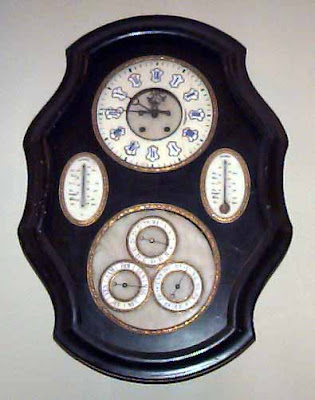
Those who visit the museum have the occasion to follow the way in which the means of measuring the time had developed, from the first "clocks"- the sun dial, the burning clocks, the clocks with water (the outline of the clock with water being taken over from d'Horologerie Ancienne) or the clocks with sand - up to the ancient mechanical clocks and modern ones. These wonderful works of horology are, often, not only the products of well-known horologists, but of men of art as well, who contributed in the way that they made the clocks as attractive as they could, creating even styles in this domain. Among the oldest pieces of the collection we name the and type pendulums, made of golden bronze, engraved or cut, sometimes with enameled dials. The oldest of the clocks, dated 1562, additionally asserts the inter crossing of preoccupations for calculating time and for astronomy, as it has astronomical dials.

Among the most valuable works of the museum's collection are the pendulums, with long cabinets and rich chiseled bronze decorations, gold pieces, exotic veneer or inlaid work. The symbols are present: the sun, the time, the child with the hourglass in his hand. The metal dial is ornate in its turn, with little enamel plates on which the ciphers are engraved. The rococo style is underlined by a few works: one of them had been created in Paris at Brulfer, in the 18th century having a wooden painted case, another work, of small dimensions, molded in brass thin paper, is decorated with a polychrome enamel painting, showing a gallant scene.

The hearth pendulum Louis XVI is another type of clock that can be identified in the museum's halls. It brings the note of refined feeling that appeared in the artistic taste during the second half of the 18th century. The urn like clock, made of Sèvres porcelain, the pendulum with venata marble columns or the small table lock suspended between colonnades, covered with an encaille enamel are some of the most beautiful exemplars of the collection. Most of the time, elements belonging to this style are found along other ornaments that belong to various artistic styles, producing that composite order, so characteristic for the 19th century.

The hall pendulums created in the Empire style, distinguish through the plasticity of feminine figures, the refined work done with the chisel and the grandeur of the artistic composition. The exhibition would not be complete without "the paintings with clocks", an attribute of the Biedermeier style. The German horologists became famous at the beginning of the 18th century by making the wall pendulums, with hand made mechanisms, kept in artistically sculpted cases, with flora and fauna motives, and birds announcing the hours. The folk influence inspired the creation of the wall clocks in straight cases, made by lathering. Some of them were created in Romania, having German or Austrian mechanisms.
The pocket watches belonging to the museum's collection are the expression of the way in which science, technique and art have contributed to the creation of one of the finest and most minute machinery. In the history of the pocket watch, invented around 1500 by Peter Henlein from Nuremberg, other names of celebrated horologists will be inscribed: Ralf Gout, Th. With, George and Edward Prior, Benjiamin Balber and others, as well as firms producing clocks/watches, which appear in impressive number beginning with the half of the 20th century.

Among the most valuable works are the hand-made clocks, created by great English, French and Dutch horologists. They reveal mechanisms of functioning, winding ringing and they were carefully created in the 17th and the 18th centuries. The chain spindle mechanism would frequently appear, being continuously improved. The gong or bell ringing belongs, also, to the beginning of the mechanical horology. Another characteristic of these clocks is the metal dial. The protection case, most of the times made of silver or baga, deep shaped (of Byzantine type), is composed of three lids. Since the first pocket watches had been made up to the moment when prestigious firms, such as Schaffhausen, Omega, Zenith, Patek Philippe and other began to create clocks, there is a span of time of two centuries. All this time the clocks reached to a high level of technical and artistic expression.

The jewel clocks, artfully created, are made of gold or silver, decorated with exquisite engravings and precious stones or with enamels of different nuances. The clocks are painted or decorated with floral, geometrical motives etc. Distinguished by their beauty, are the clocks that belonged to the Romanian kings Carol I and Carol II, those of Tzar Alexander II, the clock of the poet Vasile Alecsandri and the pendant clock of Mihail Kogalniceanu's daughter, as well as the pieces that came from the firms Genevieve Sandoz, Oudin and others. A special lace is occupied by the clocks of great personalities of the Romanian culture and political life: Constantin Brâncoveanu, Alexandru Ioan Cuza, Cezar Bolliac, Bogdan Petriceicu-Haşdeu, Ion Luca Caragiale, Duiliu Zamfirescu, Ioan Al. Bassarabescu, Alexandru Moruzzi, Mihail Kogalniceanu, Theodor Aman, Nicolae Iorga, Păstorel Teodoreanu and others.

The collection also contains some curious clocks, such as: "the invisible clock", with transparent dial and a hidden-in-frame mechanism; the "steam factory" (in miniature) made in Paris in 1800; the miller's clock, the barber's clock, the umbrella-clock, created in England; the painting-clock with mobile figurines or the stamp-clock. A last surprise for the visitors of Clock Museum, the musical boxes, which function with the help of a mechanism similar to that of a clock. The invention is dated at the end of the 19th century, when in Europe and America the devices for musical recordings began to get known.

It was inaugurated in 1963, in a hall belonging to the Culture Palace, by the care of professor Nicolae Simache, manager of History Museum between 1954-1971. Subsequently, the collection of clocks was brought into a building that had been constructed at the end of the 19th century; it belonged to Luca Elefterescu, a well-known conservative politician during the early decades of the 20th century, with several mandates of prefect of Prahova County.
Those who visit the museum have the occasion to follow the way in which the means of measuring the time had developed, from the first "clocks"- the sun dial, the burning clocks, the clocks with water (the outline of the clock with water being taken over from d'Horologerie Ancienne) or the clocks with sand - up to the ancient mechanical clocks and modern ones. These wonderful works of horology are, often, not only the products of well-known horologists, but of men of art as well, who contributed in the way that they made the clocks as attractive as they could, creating even styles in this domain. Among the oldest pieces of the collection we name the and type pendulums, made of golden bronze, engraved or cut, sometimes with enameled dials. The oldest of the clocks, dated 1562, additionally asserts the inter crossing of preoccupations for calculating time and for astronomy, as it has astronomical dials.
Among the most valuable works of the museum's collection are the pendulums, with long cabinets and rich chiseled bronze decorations, gold pieces, exotic veneer or inlaid work. The symbols are present: the sun, the time, the child with the hourglass in his hand. The metal dial is ornate in its turn, with little enamel plates on which the ciphers are engraved. The rococo style is underlined by a few works: one of them had been created in Paris at Brulfer, in the 18th century having a wooden painted case, another work, of small dimensions, molded in brass thin paper, is decorated with a polychrome enamel painting, showing a gallant scene.
The hearth pendulum Louis XVI is another type of clock that can be identified in the museum's halls. It brings the note of refined feeling that appeared in the artistic taste during the second half of the 18th century. The urn like clock, made of Sèvres porcelain, the pendulum with venata marble columns or the small table lock suspended between colonnades, covered with an encaille enamel are some of the most beautiful exemplars of the collection. Most of the time, elements belonging to this style are found along other ornaments that belong to various artistic styles, producing that composite order, so characteristic for the 19th century.
The hall pendulums created in the Empire style, distinguish through the plasticity of feminine figures, the refined work done with the chisel and the grandeur of the artistic composition. The exhibition would not be complete without "the paintings with clocks", an attribute of the Biedermeier style. The German horologists became famous at the beginning of the 18th century by making the wall pendulums, with hand made mechanisms, kept in artistically sculpted cases, with flora and fauna motives, and birds announcing the hours. The folk influence inspired the creation of the wall clocks in straight cases, made by lathering. Some of them were created in Romania, having German or Austrian mechanisms.

The pocket watches belonging to the museum's collection are the expression of the way in which science, technique and art have contributed to the creation of one of the finest and most minute machinery. In the history of the pocket watch, invented around 1500 by Peter Henlein from Nuremberg, other names of celebrated horologists will be inscribed: Ralf Gout, Th. With, George and Edward Prior, Benjiamin Balber and others, as well as firms producing clocks/watches, which appear in impressive number beginning with the half of the 20th century.

Among the most valuable works are the hand-made clocks, created by great English, French and Dutch horologists. They reveal mechanisms of functioning, winding ringing and they were carefully created in the 17th and the 18th centuries. The chain spindle mechanism would frequently appear, being continuously improved. The gong or bell ringing belongs, also, to the beginning of the mechanical horology. Another characteristic of these clocks is the metal dial. The protection case, most of the times made of silver or baga, deep shaped (of Byzantine type), is composed of three lids. Since the first pocket watches had been made up to the moment when prestigious firms, such as Schaffhausen, Omega, Zenith, Patek Philippe and other began to create clocks, there is a span of time of two centuries. All this time the clocks reached to a high level of technical and artistic expression.

The jewel clocks, artfully created, are made of gold or silver, decorated with exquisite engravings and precious stones or with enamels of different nuances. The clocks are painted or decorated with floral, geometrical motives etc. Distinguished by their beauty, are the clocks that belonged to the Romanian kings Carol I and Carol II, those of Tzar Alexander II, the clock of the poet Vasile Alecsandri and the pendant clock of Mihail Kogalniceanu's daughter, as well as the pieces that came from the firms Genevieve Sandoz, Oudin and others. A special lace is occupied by the clocks of great personalities of the Romanian culture and political life: Constantin Brâncoveanu, Alexandru Ioan Cuza, Cezar Bolliac, Bogdan Petriceicu-Haşdeu, Ion Luca Caragiale, Duiliu Zamfirescu, Ioan Al. Bassarabescu, Alexandru Moruzzi, Mihail Kogalniceanu, Theodor Aman, Nicolae Iorga, Păstorel Teodoreanu and others.

The collection also contains some curious clocks, such as: "the invisible clock", with transparent dial and a hidden-in-frame mechanism; the "steam factory" (in miniature) made in Paris in 1800; the miller's clock, the barber's clock, the umbrella-clock, created in England; the painting-clock with mobile figurines or the stamp-clock. A last surprise for the visitors of Clock Museum, the musical boxes, which function with the help of a mechanism similar to that of a clock. The invention is dated at the end of the 19th century, when in Europe and America the devices for musical recordings began to get known.
Labels:
clock,
museum,
Nicolae Simache,
Ploieşti
Sunday, January 24, 2010
The Museum of Ethnography and Folk Art Câmpulung-Muscel
The Museum of Ethnography and Folk Art in Câmpulung-Muscel is hosted by one of the oldest civil houses in town, built in 1735, monument of Romanian old architecture. The appearance is typical for a Muscel area house, with two floors, a wooden pavilion which ends in corrugated masonry arches, extended with a room in console, with columns and balusters of wood, simple plaster profiles to windows, gaps under the arches of the pavilion, and covered with wood tiles.

The building was raised in 1735 by the chancellor Ştefănescu, as the last owner was the lawyer Gheorghe Ştefănescu, hence the name of Gică Ştefănescu Villa. In 1928, it was restored by the Câmpulung architect Dumitru Ionescu Berechet, who got his doctorate in architecture with this paper, which won the Official Salon award. In 1948 the building was donated to the Romanian Academy with a view to becoming a museum, and in 1952 the Câmpulung County Museum was reorganized here. In 1977 it became the Department of Ethnography and Folk Art of the Câmpulung County Museum. The building is very old, very well maintained and used also for organizing special events, temporary exhibitions, contacts with other institutions in the country.

The museum houses exhibitions of folk art and ethnographic objects from Muscel area. The building houses valuable collections of pottery, folk costumes, and fabrics. On the ground floor we can find a homestead kitchen looking like a canvas by Nicolae Grigorescu and Ştefan Luchian; the “small house” or drawing room endowed with spinning and weaving artifacts, and next to it the “large house” or guest house. On the upper floor the exhibits include pottery artifacts reminding of the Câmpulung potter’s art of yore, a gorgeous pyrographed furniture, and an enchanting Muscel costume parade.
Labels:
Câmpulung-Muscel,
ethnography,
folk art,
museum,
muzeu
Subscribe to:
Posts (Atom)


